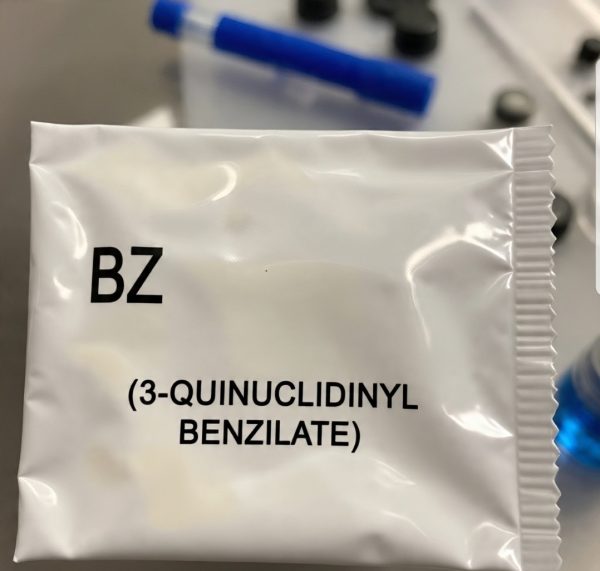
Have you ever wondered how a compound originally designed for stomach ulcers ended up as a key player in neurological research? 3-Quinuclidinyl benzilate, often abbreviated as QNB or BZ, stands at the intersection of pharmacology and neuroscience. As a researcher in Canada, you might encounter this potent anticholinergic agent while studying memory, delirium, or even Alzheimer’s models. In this guide, we’ll explore its properties, uses, and safe handling—everything to help you source and apply it ethically in your lab. Moreover, we’ll highlight why trusted suppliers like ChemLabs Canada ensure compliance and purity for your projects.
3-Quinuclidinyl benzilate is a synthetic organic compound classified as a muscarinic acetylcholine receptor antagonist. Its chemical formula is C21H23NO3, and it acts primarily by blocking cholinergic signaling in the central and peripheral nervous systems. Developed initially for medical purposes, it now serves as a vital tool in research settings. For instance, as a Canadian scientist, you’ll appreciate its role in mimicking cognitive impairments without ethical concerns over human trials.
Chemical Structure Breakdown
The molecule features a benzilic acid ester linked to a quinuclidine ring, creating a rigid structure that enhances receptor binding affinity. This bicyclic setup— with the quinuclidine nitrogen providing basicity—allows deep penetration into brain tissue. Additionally, the ester bond contributes to its lipophilicity, enabling it to cross the blood-brain barrier efficiently. In research, understanding this structure helps predict interactions with other neurotransmitters.
Common Synonyms
Researchers often refer to it as BZ (military code), QNB, or Agent 15. These names stem from its historical use, but in academic papers, the full IUPAC name—benzilic acid 3-quinuclidinyl ester—prevails. Furthermore, avoid confusion with similar esters like tropic acid derivatives. If you’re searching PubChem, use CID 23056 for quick access.[Link to PubChem external resource]
Role in Research
Primarily, 3-Quinuclidinyl benzilate probes muscarinic receptors in studies on psychosis and memory loss. For example, it induces Alzheimer’s-like symptoms in rodent models, aiding drug development. In Canadian labs, it’s used ethically under strict protocols, emphasizing its value in non-human applications.
The journey of 3-Quinuclidinyl benzilate began in the mid-20th century amid pharmaceutical innovation and Cold War tensions. Synthesized in 1951, it quickly shifted from therapeutic hopes to military interest due to its profound effects on cognition. Today, it informs ethical research, reminding us how discoveries evolve.
Early Discovery
Swiss firm Hoffman-LaRoche created it as an antispasmodic for ulcers, but hallucinogenic side effects halted clinical trials by 1952. However, this potency caught the eye of U.S. researchers exploring non-lethal agents. Consequently, by 1955, Edgewood Arsenal began toxicity studies.
Scientific Milestones
In 1961, the U.S. Army standardized BZ production, testing it on volunteers to assess incapacitation—revealing delirium lasting up to 96 hours. Production peaked in 1964 but ended due to delivery challenges. On the other hand, its pharmacological insights influenced 1970s neuroscience, including receptor mapping.
Evolution in Canadian Labs
Canadian institutions adopted it post-1980s for controlled studies, aligning with Health Canada guidelines. For instance, universities like UBC have used it in behavioral pharmacology since the 1990s, focusing on safe, regulated applications.[Link to internal Canadian research archive]
This compound’s traits make it ideal for lab stability yet challenging for handling. With a molecular weight of 337.42 g/mol, it’s a white, odorless powder that’s bitter to taste. As you prepare solutions, remember its sensitivity to bases ensures predictable reactions.
Molecular Weight and Formula
C21H23NO3 yields 337.42 g/mol, facilitating precise dosing in microgram scales. This low volatility suits aerosol or oral research models. Moreover, its formula supports easy NMR characterization for purity checks.
Property
Value
Relevance to Research
Molecular Formula
C21H23NO3
Basis for synthesis analogs
Molecular Weight
337.42 g/mol
Enables low-dose efficacy studies
CAS Number
6581-06-2
Standard for regulatory compliance
Solubility and Stability
Soluble in ethanol (up to 50 mg/mL) and chloroform, but only 0.1 mg/mL in water—requiring DMSO for aqueous work. Stable at room temperature, yet alkaline hydrolysis yields benzoic acid and quinuclidinol. Therefore, store in acidic buffers for longevity.
Physical Appearance
Appears as fine, white crystals, non-hygroscopic under dry conditions. In labs, this uniformity aids in weighing, but always verify with melting point (158–160°C) tests.
SYNTHESIS AND PRODUCTION OF 3-QUINUCLIDINYL BENZILATE
Crafting 3-Quinuclidinyl benzilate involves esterification, a straightforward yet precise process. Labs scale it from milligrams for research, ensuring >99% purity. At ChemLabs Canada, we prioritize GMP-like standards for your supply chain.
Lab Synthesis Methods
React 3-quinuclidinol with benziloyl chloride in pyridine, yielding 80–90% after recrystallization. Alternatively, transesterify methyl benzilate with excess quinuclidinol in refluxing heptane. For example, this method minimizes byproducts, ideal for isotopic labeling.
Industrial Scaling
Historical U.S. production used batch reactors, but modern scales employ continuous flow for safety. Challenges include handling toxic intermediates, so ventilated hoods are essential. In addition, yields reach 95% with catalyst optimization.
Purity Standards at ChemLabs Canada
ChemLabs tests via HPLC to >99.5% purity, exceeding pharmacopeia norms. Our batches include CoA with lot-specific data, ensuring traceability for Canadian grants.[Link to ChemLabs purity certificate page]
Beyond its past, 3-Quinuclidinyl benzilate shines in probing cholinergic pathways. Canadian researchers use it to model dementia, advancing therapies ethically. You’ll find it indispensable for in vitro binding assays.
Pharmaceutical Research
It screens muscarinic antagonists for glaucoma or IBS drugs, blocking M1–M5 receptors selectively. For instance, dose-response curves reveal IC50 values under 1 nM.
Material Science Applications
Rarely, it functionalizes polymers for drug delivery, leveraging its ester reactivity. However, primary focus remains neuropharmacology.
Biological Studies
In vivo, it disrupts learning in rats, mimicking cholinergic deficits. Bullet points for quick reference:
Induces spatial memory loss in Morris water maze tests.
Used in optogenetics to validate receptor roles.
Supports CRISPR studies on acetylcholinesterase.
BIOLOGICAL EFFECTS OF 3-QUINUCLIDINYL BENZILATE
This agent’s effects stem from competitive inhibition at muscarinic sites, far outpacing natural acetylcholine. In research, low doses (1–10 µg/kg) suffice for targeted impacts, but monitor for off-targets.
Mechanism of Action
Binds irreversibly to M1/M2 receptors, halting parasympathetic signals. Consequently, it elevates heart rate and dilates pupils. Central effects include euphoria at low doses, escalating to hallucinations.
Dosage Considerations
Start at 0.5 mg/kg IV in models; human-equivalent research avoids direct dosing. Adjust for species—mice need 20x less than primates. Always titrate to avoid toxicity.
Potential Interactions
Synergizes with opioids for respiratory depression; antagonizes physostigmine reversal. Table of interactions:
Drug Class
Effect with QNB
Research Implication
Cholinergics
Antagonism
Reversal agent studies
Antidepressants
Enhanced delirium
Polypharmacy models
Sedatives
Prolonged sedation
Sleep disorder analogs
SAFETY AND HANDLING GUIDELINES FOR 3-QUINUCLIDINYL BENZILATE
Safety first: This Schedule 3 toxin demands PPE and ventilation. As a Canadian lab worker, follow WHMIS protocols to mitigate risks.
Toxicity Profile
LD50 oral (mice): 46 mg/kg; inhalation poses aerosol hazards. Acute exposure causes mydriasis and confusion; chronic risks include cognitive fog. Not for human consumption—research only.
Storage Best Practices
Keep in amber glass at 2–8°C, away from bases. Use desiccators to prevent moisture. Numbered list for protocols:
Label with hazard diamonds (toxic, irritant).
Limit access to trained personnel.
Inventory quarterly per Health Canada.
Emergency Procedures
If exposed, flush skin/eyes 15 min; seek atropine/physostigmine antidote. Ventilate spills with HEPA filters. Call poison control immediately.
Disclaimer: For legitimate research only. Consult local regulations.
LEGAL STATUS OF 3-QUINUCLIDINYL BENZILATE IN CANADA
Canada regulates it under the Chemical Weapons Convention Act as a toxic chemical (Schedule 3). Legitimate research permits exempt it from full controls.
Health Canada Guidelines
Requires declaration for >100g imports; labs must report via NPRI. Ethical use in academia is encouraged with IRB approval.
Controlled Substances Act
Not a narcotic, but precursor B status mandates tracking. Violations incur fines up to $500,000.
Import/Export Rules
CBSA clears with export permits from origin. ChemLabs handles compliance seamlessly.[Link to Health Canada CWC page]
3-QUINUCLIDINYL BENZILATE VS. SIMILAR COMPOUNDS
Compared to atropine, QNB is 25x more potent centrally. Choose based on duration needs.
Key Differences from Atropine
QNB lasts 72+ hours vs. atropine’s 4–6; better CNS penetration. However, atropine is cheaper for peripheral studies.
Advantages Over Scopolamine
Less sedating, more hallucinogenic—ideal for psychosis models. Scopolamine crosses BBB faster but clears quicker.
When to Choose 3-Quinuclidinyl Benzilate
Opt for long-term cholinergic blockade in chronic models. Bullet points:
High-affinity binding for radioligand assays.
Stability in vivo for extended experiments.
Ethical edge in non-lethal research simulations.
ADVANCED RESEARCH APPLICATIONS OF 3-QUINUCLIDINYL BENZILATE
Cutting-edge work leverages QNB in AI-driven simulations of neurodegeneration. Canadian teams at McGill explore its dual-use potential responsibly.
In summary, this compound unlocks cholinergic mysteries safely.
Key Takeaways
Potent tool for neuroscience.
Strict handling ensures ethics.
ChemLabs delivers excellence.
Next Steps with ChemLabs Canada
Order today for compliant supply.
Resources for Further Reading
PubMed reviews, Health Canada docs.[Link to resources page]
Ready to source premium 3-Quinuclidinyl Benzilate? Visit ChemLabs Canada today for fast, compliant delivery.
FAQ Section
Is 3-Quinuclidinyl Benzilate Legal for Research in Canada? Yes, under controlled conditions. What Are Its Primary Research Uses? Modeling delirium and receptor antagonism. How Toxic Is It? Moderately; LD50 46 mg/kg oral. Can It Be Used in Humans? No—research only, not consumption. What’s the Best Storage Method? Cool, dry, sealed. Does ChemLabs Ship to All Provinces? Yes, with tracking. How to Verify Purity? HPLC/NMR per CoA.

Reviews
There are no reviews yet.